Technically speaking, the iPhone 5 is already jailbroken. You’re just
not allowed to have it yet. The reason for this is because one of the
bugs that contributes to a functional jailbreak is so good, that the
hackers who discovered it would rather hang on to it while looking for
another to replace it, instead of releasing it out into the wild where
Apple could learn of the exploit, and patch it. Plus, iOS 6.1 is on the
horizon, so they definitely don’t want to release the bug before then.
“This vulnerability is nice because it lets us see what’s going on,”
Wang tells me. “We need to be able to look at the code we’re trying to
change – get a dump of it. Otherwise, we’re basically working on things
in the dark.”
The worst case scenario here is that the hackers have to “burn” their
current exploit – this great bug they have – in order to get a
jailbreak into the hands of the public. They just don’t want to do that
yet. Besides, the fact that there were four bugs discovered on the
iPhone 5 at the time of that Reddit post was promising. That leaves hope
that they’ll be able to find a few more. And so far,
progress on that front looks good.
So will end users ever be able to jailbreak the iPhone 5, then? Yes,
Wang says. This year? Well, he sure hopes so. At least before the next
iPhone comes out.
The Days Of Yore
Finding exploits isn’t like building an app or website where every
day, you would see progress. Instead, bug hunting is like panning for
gold. And there might not be any gold to be found.
For those unfamiliar with jailbreaking, or why anyone would want to
go to such efforts to have control over their phone, the activity
originally became popular because it allowed users to add applications
and features Apple didn’t approve. Users could turn their phones into a
Wi-Fi hotspot, install custom themes, make the device’s settings and
controls more accessible, override Apple’s default restrictions, and
more. Some users even unlocked their phones to run on unapproved
cellular networks.
In the old days, jailbreakers were more competitive, organizing themselves into “teams” like the
iPhone Dev Team and the
Chronic team.
A few rogue developers even operated independently. Hackers competed
against and surprised each other – and jailbreaking users, too – with
their releases.
Now the jailbreaking vibe feels different. The individuals involved
are generally working together and sharing knowledge when appropriate.
The competitiveness has been dialed down. Each person works on their own
piece. Everyone commits their piece to the same
GitHub repo, and the code from there will then be turned into a user-facing jailbreaking tool.
And it’s not always the same people who work on each device’s
jailbreak these days, Wang explains. It’s whoever has the time and
energy. “Over time, the teams have broken down a bit,” he says. “The
team structure doesn’t really work. It promotes rivalries and you can’t
work with who you want. What we have now is better – we work with each
other and share knowledge, but it’s kind of compartmentalized. Instead
of sharing it with a whole team, we just share with an individual what
we think they need to know.”
Call it a kinder and gentler hacking scene, perhaps.
This time around, work on the latest iPhone jailbreak has been
delayed a bit, but not only because of the hardened iOS 6 operating
system, but because of other demands on jailbreakers’ time. Like their
day jobs. Wang has a full-time day job in a different field. Another of
the iPhone 5′s hackers, @Pod2G,
has been busy working on his own iOS app, for instance.
In Search Of Exploits
There are other things that slow down the process between finding the
bugs and releasing the jailbreak tool: for example, finding the
differences in the code between the different devices and testing
procedures. When the jailbreak is done, it can also be challenging to
find someone who’s savvy enough to test it, but who won’t leak it
publicly. “It can take a couple of days, or a couple of weeks sometime,”
says Wang.
It wasn’t always this hard.
In the past, jailbreakers were able to find bugs in the
bootrom,
the first significant code that runs on the iPhone, and they were in.
They would have full control over that phone for as long as that device
existed, no matter what version of iOS was running. But now, devs can’t
even access the bootrom.
“The bootrom has been getting smaller and smaller, but we can’t even
get a dump of it right now. Even if we get code controlling the entire
phone running, like we do, we can’t see the bootrom. And if we can’t
dump it, we can’t look for code and mistakes very easily,” Wang says.
The reason for this is because today, when the iPhone 5 boots up fully,
it now hides the bootrom. This has been the case since “
Limera1n”
took advantage of an undisclosed bootrom exploit on the iPhone 4 (and earlier devices), which Apple has since fixed.
Did Apple patch the bootrom only because of jailbreaking?
“It sure seems like it, because who else would care about reading the
bootrom? You can’t really get a virus on your phone by reading the
bootrom,” Wang says.
Today, with no bootrom bug available, hackers now need to find a lot
more bugs to have a complete jailbreak solution for users. You need the
code injection bug (which puts the code on the operating system), and
something that increases the privilege level of that code so it can
change things on the operating system on the phone. This bug can
sometimes be the same as the code-injection bug.
Then you need a kernel injection bug, which gives you unrestricted
access to the operating system and tells the kernel to stop checking for
code signatures. And more recently, because of iOS 6, you need
something to address kernel
ASLR (address space layout randomization), which moves the kernel around in memory.
Apple doesn’t let the jailbreakers see where the kernel is in memory,
to prevent exactly what they’re trying to do, says Wang. So you need to
find a bug that can get around kernel ASLR, too, and it might be the
same bug as the one that increases the privilege level of code or the
kernel injection bug.
And then you need to find an untether bug so the jailbreak runs whenever and wherever the iPhone boots up.
Yes, that’s a lot of bugs.
A Very Brief History Of Jailbreaking
But to fully understand how iPhone jailbreaking has gotten more
difficult over the years, you have to have a sense of history. You have
to understand what’s it’s been like and how that has changed.
When the iPhone 3G came out, a jailbreak tool called
PwnageTool
emerged. It was based on a bootrom exploit that allowed the iPhone’s
hackers to change out the software on the device. Basically, it’s like
changing software out on a computer – for example, you have a computer
that runs Windows, and you install Linux on it. In terms of jailbreaking
an iPhone, this is pretty powerful access.
Later, when the iPhone 3GS came out, the key bug that allowed the
developers this level of access was still there. Well, at least until
sometime around halfway through the iPhone 3GS’s cycle when Apple
decided to shut down manufacturing temporarily to address the problem.
After production resumed, there was a new bootrom in place and the bug
was gone.
“Certainly their motivation was that there was a bug and they wanted
it to be fixed,” says Jay Freeman, who created the jailbreak “app store”
known as
Cydia – which users install after their phone is jailbroken. “But exactly why they considered
that
bug more important to fix than any other bug they’ve not fixed, I don’t
really know…We’ve never had a better exploit than that.”
But that didn’t prevent the hackers from looking for other means to break into the iPhone’s code.
Immediately after Apple patched the one bootrom bug, jailbreakers
were able to discover other bootrom bugs, but only those that could
change the software temporarily. To continue the Windows analogy, this
would be like booting up a computer from a CD, USB or floppy disk –
you’re not really installing the software from scratch here.
On an iPhone, that means the jailbreaks could temporarily boot the
phone up with a new kernel that doesn’t protect the phone’s software,
mount the hard drive of the device and change the software on the iPhone
to do different things – that is, run all those jailbreak apps that
modify how the iPhone behaves.
But the kernel is still protected, because the bootrom was not
modified or damaged, which means the next time the phone is booted, the
jailbreak is undone. This is what’s called a “tethered” jailbreak,
referring to the fact that the phone has to be plugged in to a computer
when the jailbreak is performed and then each time the phone is
rebooted. By the time the iPhone 4 came out, jailbreakers had to find a
bug in a program running on the phone normally that they could use to
access a bug in the kernel, which they could then use to modify the
kernel. This would allow them to modify other software on the phone.
A famous example of this was
the JailbreakMe website, which a jailbreaker known as
@comex
(aka Nicholas Allegra) discovered. This method used a bug in the web
browser that could crash the browser and take control of it, in order to
then get arbitrary code running in the kernel.
“Comex was just ludicrous,” Freeman says. “He found so many exploits in all sorts of things.”
(
Comex was later hired by Apple,
but we’ve heard he wasn’t working on anti-jailbreak measures while
there. Wang tells us that users waiting for jailbreaks shouldn’t be
significantly worried about Apple hiring from the jailbreaking
community, either.)
The big next step was to make this jailbreak “untethered” – a device
that can boot up directly to the jailbreak. This requires leaving some
kind of code around that will cause the software to trip up upon boot,
de-securing the device along the way. In the absence of a bootrom bug,
like the one found on the iPhone 3G or 3GS, this was the best way for
some time to achieve an untethered jailbreak.
A New iPhone, A New Search
Every time a new iPhone came out, the search for bugs begins anew. As was the case when the iPhone 4 came out.
On a memorable day – 10-10-10 – some members of the jailbreaking community were ready to release a tool called
SHAtter, but before they did another hacker known as
Geohot came out of nowhere
with his Limera1n exploit for the iPhone 4 and iPad. Others, including
@Pod2G, @Comex and @i0n1c, then worked to find untethers for that
jailbreak.
Limera1n was important because, unlike the JailbreakMe webpage, which
takes advantage of easily patchable software running on the phone (the
browser), a bootrom exploit lasts for the entire life of that device.
“In order to upgrade the bootrom, you have to throw out your phone
and get a new one…so [Apple] can’t ever upgrade Limera1n,” Freeman
explains. “Limera1n is stuck on every device that ever shipped that had
that bug.” The exception is if Apple goes out of its way to stop
production, like it did with the 3GS, to fix the bug.

The
cat-and-mouse game between Apple and the jailbreaking community
continued when the iPhone 4S came out. The exploit that Limera1n used
was gone. That sent the hackers back to looking for what they call
“userland” exploits – those bugs in the software (like the browser, as
with JailbreakMe), which, when identified and used to develop a
jailbreaking tool, are then likely to be patched by Apple in the very
next firmware upgrade, e.g. iOS 4, iOS 5, iOS 6 and its minor releases.
Hackers refer to this as “burning” the exploit, as it can never be used
again after that point, since Apple always patches them.
Corona
was the name of the userland exploit that allowed a jailbreak for the
iPhone 4S, running iOS 5.0 and 5.01. Then Apple released iOS 5.1 and the
bug was gone. So hackers created yet another jailbreaking tool,
absinthe, that worked on iOS 5.1 and 5.1.1. Apple released iOS 6 and the bugs were gone again.
“iOS 6 has had significant security improvements. And iOS 6.1 also
has even more improvements,” says Wang. “One of the things we’re having
trouble with [on the iPhone 5] is the initial injection,” he explains.
Now remember that the iPhone 4 is not affected by all these iOS
releases. Because Limera1n uses an unpatched bootrom exploit, it doesn’t
matter what version of iOS runs on that device. It can be jailbroken.
This, of course, raises the question: If bootrom exploits are that
powerful, why don’t the hackers just look for them?
The answer is it’s not that simple.
“Finding bootrom exploits is more difficult only because there is
much less software. We talk about this thing called an attack surface,”
says Freeman. He likens it to the way a very large army wearing lots of
battle armor probably has a break in it somewhere that you can poke a
sword through. Meanwhile, a small army would be more likely to be
protected fully. The only thing a bootrom does is verifies the other
software, and it talks over USB. There’s not a lot of code in there.
Most of the bootrom bugs have been found in the USB setup code. Most of those bugs have been fixed.
However, in the iPhone 5, Apple added a Lightning connector, so there’s now a chance that there is a bug in the new bootrom – if hackers were to find a way to peek in there, which as noted above, they currently can’t.
So for now, it’s about finding non-bootrom bugs. And it’s been
tougher to do so lately. There isn’t a good jailbreak for the iPhone 4
or iPod 4, only a tethered one. There’s no publicly available jailbreak
for iOS 6 on the iPhone 4S or iPhone 5.
Like Dealing With Magicians
It’s hard to always know what’s going on with the current jailbreak.
When jailbreak developers and other hackers are teasing their progress
on Twitter,
they’re sometimes showing off
some of those so-called userland bugs in action. Maybe they show Cydia,
Freeman’s app store for the jailbreaking community, running on their
device. But Freeman clarifies that these teases are often only partial
jailbreaks – Cydia is installed, but the apps that let you have all the
fun wouldn’t necessarily work. Other times, they’ve used Apple’s own
developer tools, which allow Apple’s paying developers to install their
own code on the phone. Seeing a device running Cydia, in other words, is
not proof that a jailbreak for
you, the
user, is ready.
Sometimes, however, it is a hint at progress.
“It’s a little bit like dealing with magicians. You might know how
somebody’s trick works, but it’s their trick,” says Freeman. “A lot of
the hacking community has that same kind of vibe to it. Somebody has
managed to figure out how to do something weird.” Instead of hacking
your brain, as magicians do, they’ve hacked a phone, he says.
For example, the recent demonstrations by @chpwn and @phoenixdev were
totally legitimate, but they did not have kernel patches and so were
not “complete” enough to do most of the things that people expect a
jailbroken device to do, says Freeman. “They were only half-jailbroken.”
The trick is knowing which jailbreak developers you can trust. While
it’s possible there’s still a chance someone will come out of nowhere,
like Comex did back in the day, it’s a better bet that future jailbreaks
come from those who have been consistently working on jailbreaking
Apple’s devices over the years.
If They Jailbreak It, Will Users Come?
But when the iPhone 5 jailbreak arrives, the bigger question may be
whether it will again draw a significant number of users, as it had in
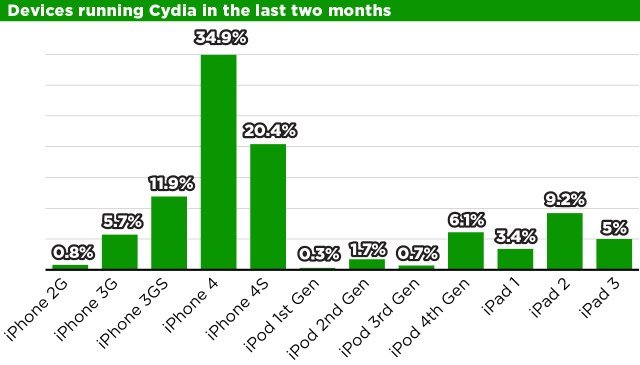
years past. Freeman says that, based on data over the past two months,
he has seen 22,780,029 devices running Cydia, to give you an idea of
scale. But of course, this includes more than iPhones – it counts iPads
and the iPod touch, as well. Plenty of users still have iPhone 4′s and
4S’s too, it should be noted.
Freeman says that in between the releases of jailbreaking tools,
Cydia installs begins trending downwards, but when the next big
jailbreak tool is goes out, the number of Cydia installs has always been
more than the time before.

“Every
time we release jailbreak, we get a massive spike of renewed interest,
during which time people furiously are upgrading, jailbreaking, browsing
packages, and purchasing products,” Freeman says. “They are seriously
active users; that spike is so large that the rate it falls over time
swamps the rate of organic user accumulation, so the overall usage of
jailbreaking is always going down.”
Is The Time For Jailbreaking Over?
In these quiet periods, though, there’s room for doubt that anyone
still wants to jailbreak their phone. After all, Apple has addressed a
lot of the things jailbreakers were after: It now has a drop-down
notifications window and lets you put a wallpaper on the lock screen,
for example.
FaceTime on AT&T works over 3G/4G now. The
iPhone is coming to T-Mobile,
so you won’t need to jailbreak, then use an unlocking tool to make the
phone compatible on T-Mobile. You can even buy unlocked phones, and it’s
easier to just pay for a Wi-Fi hotspot feature with your carrier than
it is to jailbreak and install software to make one work.
Freeman doesn’t think the lack of a jailbreak for the iPhone 5 is the main reason for the recent disinterest. It’s the type of jailbreaks that have been available lately for the most popular devices.
“We have to look at iOS 6: we don’t have a ‘good’ jailbreak for iOS 6
on the iPhone 4 or iPod 4 (as it is tethered),” he says, “and we have
no jailbreak for iOS 6 on any of the newer devices, including last
year’s iPhone 4S.”
“We all think that the popularity of jailbreaks is going down because
of all the improvements Apple has made, but it seems to be still pretty
popular,” Wang notes, however. And the fact that his Reddit post blew
up, is also promising.
He admits that those working on the jailbreaks may not communicate with users as often as they did in the past.
“I don’t maybe make as much of an effort as maybe I should, because
in a way, it’s always kind of hopeless. There’s always people who don’t
read, or choose to misinterpret what you say,” he says. “It’s so
difficult to not be misunderstood. Sometimes you don’t even want to
bother trying.”
But he does still try.
Just this weekend, for example,
Wang and fellow jailbreaker
@Pod2G tweeted that they made progress in finding more bugs, which hopefully brings us closer to a public jailbreak.
The iPhone 5 jailbreak, however it comes to be, could breathe new
life into the jailbreaking scene and into a community which even grew
large enough to
have its own convention.
And it will also answer the question as to whether all those millions
of users are still interested in taking the plunge and jailbreaking
their phones, or whether they’ve become comfortable enough with the
status quo in these many months without a usable, untethered jailbreak
on hand.
Wang, of course, and others like him, never had to take time off from
using a jailbroken device. “My iPhone is always jailbroken,” he said.
And maybe one day soon, your iPhone can be jailbroken again, too.